Lost bone doesn't have to mean lost hope. Bone grafting makes implants possible for almost everyone.
Building the Foundation for Implants
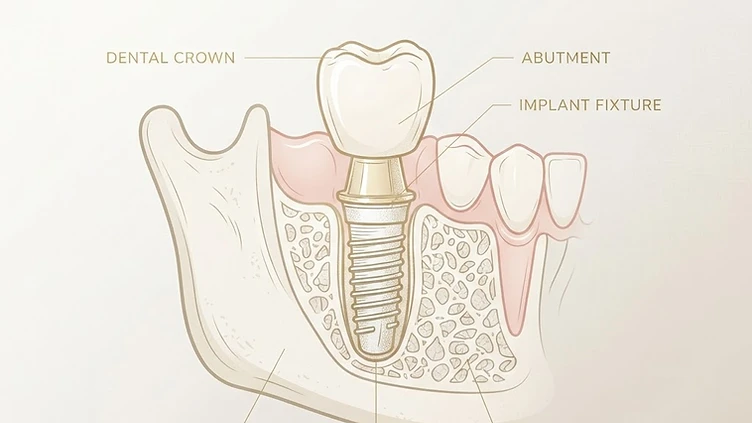
Bone grafting is the process of rebuilding or strengthening the jawbone so it can support a dental implant. When a tooth is lost, the bone beneath it gradually shrinks — sometimes leaving too little bone to place an implant securely. Bone grafting restores that volume, making implants possible for almost everyone, even when bone loss has occurred.
The Techniques I Use
There are several approaches to bone grafting. In my practice, I rely mainly on the following:
Artificial Bone (Xenograft)
The most common technique uses an artificial bone material called a xenograft — derived from animal bone (typically bovine). This material is highly biocompatible and acts as a scaffold: it holds the space and provides a structure for your own natural bone to grow into and replace over time. The graft is gradually resorbed and replaced by living bone, leaving a strong, stable foundation for your implant.
Your Own Bone (Autograft)
In some cases, I use the patient's own bone. This can be collected painlessly with fine instruments from inside the mouth — often from near the implant site or from the jaw. Because it is living tissue, it contains natural bone-forming cells that encourage rapid healing and integration. The procedure is gentle and comfortable, with minimal discomfort.
What to Expect
Both techniques are carried out comfortably under local anaesthetic. The graft is placed at the site where the implant will go — sometimes at the same time as tooth removal, sometimes a few months beforehand. The area is then left to heal for 3 to 6 months while new bone forms around and through the graft, creating a solid base for your implant.
The Verdict
Bone grafting is a predictable, well-established procedure that makes dental implants possible for patients who would otherwise be told they aren't suitable. With modern grafting materials and gentle techniques, rebuilding your smile is more achievable than ever.
Book a consultation to find out if bone grafting could help you.

